
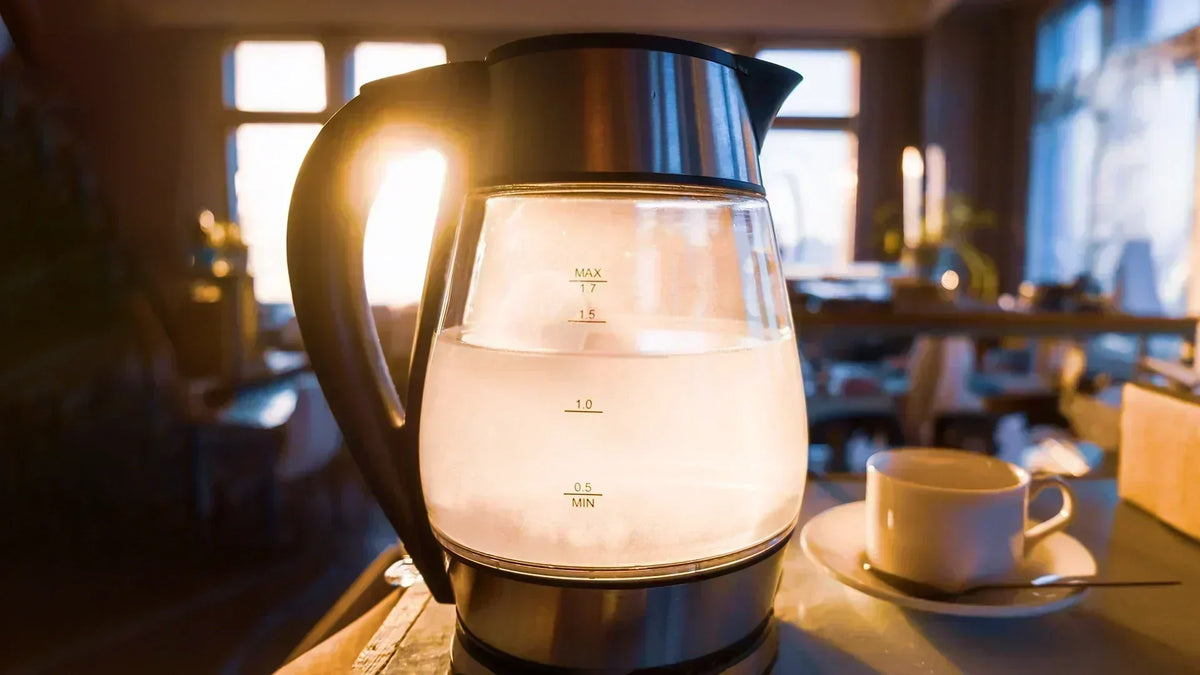
Short answer: no – limescale is a mineral deposit, not a health risk. Here is what it is, why some homes get so much of it, and what actually helps.
━━━
Limescale is not bad for your health. The white, chalky deposit that hard water leaves behind consists mainly of calcium and magnesium – minerals your body needs every day. Drinking hard water is safe, and it even contributes small amounts of both minerals to your diet.
Limescale forms when hard water is heated or left to evaporate. The dissolved minerals come out of solution and settle as a solid layer – the lime from water that coats kettles, taps and shower screens.
The hardness itself begins long before your tap. Rainwater percolates through limestone or chalk, dissolves calcium and magnesium on its way down, and carries both into the groundwater. Water treatment often does not remove these minerals, so the water that reaches your home reflects the geology of your region. That is why neighbouring towns can have very different water.

How to read your result: below 1.5 mmol/l counts as soft, above 3.8 mmol/l as very hard – the harder the water, the faster scale forms. (© BRITA SE)
Water hardness is measured in millimoles per litre: below 1.5 mmol/l counts as soft, above 3.8 mmol/l as very hard.
Harmless for you does not mean harmless for your home. In kettles and coffee machines, limescale settles on heating elements, makes them work harder and can shorten their life. It also changes how drinks taste: hard water mutes fine aromas and leaves a visible film on tea. The opposite extreme has drawbacks too – fully demineralised water tastes flat, because calcium and magnesium carry much of water's taste.
So the useful questions are practical ones: how hard is the water where you live – and what helps where limescale actually causes trouble?
What causes limescale in kettles and pipes?
Not all hardness behaves the same way. Part of it – carbonate or ‘temporary’ hardness – is dissolved calcium bicarbonate. Heat breaks it down into solid calcium carbonate, which is why scale appears first wherever water gets hot: kettle elements, boiler coils, coffee machines.
On taps and shower screens the trigger is evaporation instead: the water disappears, the minerals stay. The harder your water, the faster both processes run.

Two ways limescale forms: heat breaks down carbonate hardness in kettles; evaporation leaves minerals behind on taps and screens. (© BRITA SE)
How do I know if my water is hard or soft?
Three reliable routes:
- Check your water hardness by postcode. Every water supplier publishes local hardness data online – the direct route to the level for your area.
- Test it yourself. Simple hardness test strips show the result in minutes, in mmol/l or mg/l – available from pharmacies or online for a few pounds.
-
Read the signs. Fast-scaling kettles, spotted glassware and film on hot drinks all point to hard water.
How to get rid of limescale – and keep it away
Existing deposits respond to acid: household vinegar or citric acid dissolve limescale on taps, shower heads and in kettles – soak, wait, rinse. Boiling water and pouring it through a paper filter also works, but it is slow and simply moves the scale into your kettle.

Not a work of art – limescale, photographed up close. Calcium and magnesium carbonate, left behind on the base of a kettle. (© iStock)
Prevention starts with the water itself. Filtration by ion exchange resins reduces carbonate hardness before the water is heated, so less scale can form in the first place – and softer water changes how coffee and tea taste.
For drinking, remember the balance: the goal is less scale where it does damage, not water stripped of its minerals.
━━━
Sources and further reading:
- World Health Organization (WHO)
- Drinking Water Inspectorate (DWI)
- Affinity Water
- Science Insights
- Global Water Research Coalition
Last reviewed: July 2026
